

Sealed vs Shielded Bearings: 2026 Engineer's Guide
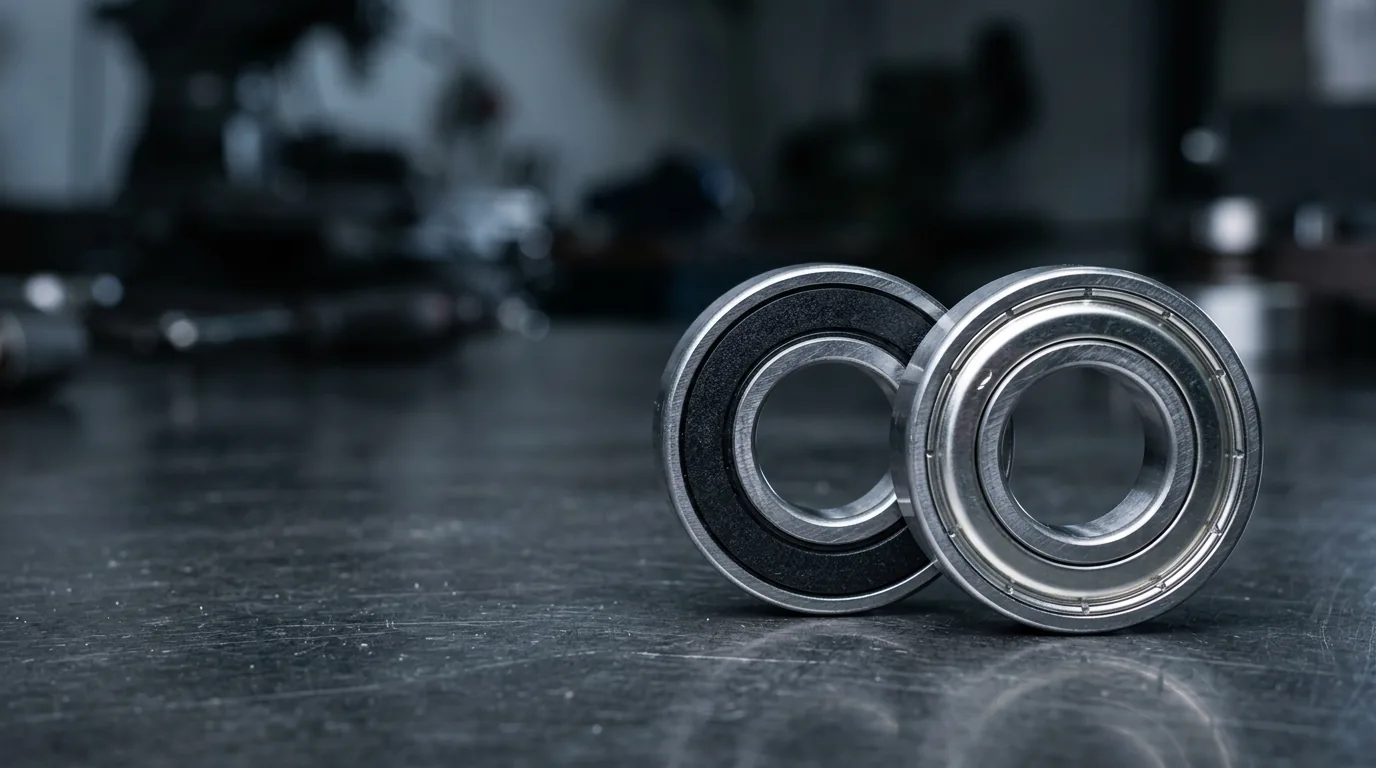
Sealed bearings (2RS) use rubber contacts to block heavy contamination, while shielded bearings (ZZ) use non-contact metal plates for high-speed applications requiring low friction. Rubber-sealed bearings, marked with a 2RS suffix, provide superior protection against moisture and particle ingress in high-dust manufacturing and washdown zones. Conversely, shielded bearings, designated by the ZZ suffix, operate with zero contact friction, allowing them to achieve higher RPM speed ratings than rubber-sealed alternatives.
For maintenance-free inventory, our team at HI-TEC ASIA recommends prioritizing 2RS seals for severe contamination risks and ZZ shields for high-speed, low-friction requirements. This technical guide breaks down the mechanical differences, speed limitations, and environmental criteria for selecting the correct bearing enclosure for industrial machinery.
What is the difference between sealed and shielded bearings?
Sealed bearings (2RS) use rubber contacts to block heavy contamination, while shielded bearings (ZZ) use non-contact metal plates for high-speed applications requiring low friction. The physical design of the closure dictates the bearing's operational limits, determining whether it can survive in a slurry pump or spin efficiently in a high-speed spindle. Contact seals drag against the inner ring to form a physical, impermeable barrier. In contrast, metal shields hover slightly above the inner ring, leaving a microscopic gap that eliminates friction but sacrifices environmental protection.
For maintenance-free bearing inventory, HI-TEC ASIA recommends prioritizing 2RS seals for severe contamination risks and ZZ shields for high-speed, low-friction requirements. Selecting the wrong enclosure often leads to premature catastrophic failure. If a shielded bearing is deployed in a wet environment, the grease will wash out. If a sealed bearing is pushed beyond its thermal limits in a high-speed electric motor, the rubber lip will melt or degrade.
| Feature | Sealed Bearings (2RS) | Shielded Bearings (ZZ) |
|---|---|---|
| Closure Material | Synthetic rubber (elastomer) | Stamped steel plate |
| Inner Ring Contact | Full physical contact | Non-contact (small gap) |
| Contamination Protection | High (blocks fine dust and liquids)[1] | Moderate (blocks large debris)[1] |
| Friction & Heat | Higher drag and heat generation[2] | Negligible friction[2] |
| Maximum Speed | Lower RPM limit[3] | Higher RPM limit[3] |
| Lubricant Retention | Excellent | Good |
What does 2RS and ZZ mean on a bearing?
The suffixes 2RS and ZZ designate the type and quantity of closures on a rolling bearing: 2RS indicates two rubber seals, while ZZ indicates two metal shields[4][5]. These standardized alphanumeric codes are appended directly to the base bearing number (for example, 6204-2RS or 6204-ZZ) to specify the exact enclosure design for procurement and maintenance engineers[5].
Rubber-sealed bearings, marked with a 2RS suffix, provide superior protection against moisture and particle ingress in high-dust manufacturing and washdown zones. Breaking down the nomenclature, the "2" specifies that closures are present on both sides of the rolling elements, and "RS" stands for a synthetic rubber seal[5]. Because these elastomer seals make direct physical contact with the inner ring, they trap the factory-filled grease inside the raceway while actively blocking external contaminants[1]. This makes 2RS the default standard for maintenance-free bearings in harsh industrial conditions.
Shielded bearings, designated by the ZZ suffix, operate with zero contact friction, allowing them to achieve higher RPM speed ratings than rubber-sealed alternatives. The "Z" denotes a single metal shield, making "ZZ" a double-shielded bearing[6]. These stamped steel plates are permanently fixed to the outer ring and do not touch the inner ring. Instead, they leave a microscopic clearance gap that minimizes rotational drag. While this gap is small enough to keep the internal grease in place under normal conditions, it allows microscopic particles, vapors, and moisture to pass through[2]. Understanding these suffixes ensures that plant managers do not accidentally install a high-friction seal where a low-friction shield is required.
Do sealed bearings have lower speed limits than shielded bearings?
Yes, rubber-sealed bearings (2RS) reduce the maximum RPM speed rating by approximately 20% to 40% compared to metal-shielded (ZZ) bearings[7]. The physical contact of 2RS rubber seals generates heat at high speeds, which lowers their maximum safe operating RPM limit[8]. Engineers must calculate these thermal limits before specifying a bearing for high-speed machinery.
Shielded bearings, designated by the ZZ suffix, operate with zero contact friction, allowing them to achieve higher RPM speed ratings than rubber-sealed alternatives. When evaluating high-speed bearing selection, our team advises engineers to account for the specific mechanical steps that dictate a bearing's speed capacity:
- Seal Contact Friction: The synthetic rubber lip of a 2RS seal physically rubs against the rotating inner ring. This continuous mechanical interference generates parasitic drag and heat that a non-contact ZZ shield completely avoids[9].
- Thermal Degradation: The additional heat from contact seals transfers directly into the bearing's raceway and lubricant. At high RPMs, this heat degrades the internal grease faster, forcing bearing manufacturers to artificially lower the safe speed rating to prevent thermal runaway[10].
- RPM Reduction Example: The speed penalty is substantial in real-world applications. For instance, a standard 6200 ZZ bearing may be rated for 24,000 RPM, while the exact same bearing in a 6200 2RS configuration is limited to just 18,000 RPM - a 25% reduction in speed capacity purely due to the seal[11].
- Energy Efficiency: In massive industrial plants with thousands of rotating components, the cumulative drag of 2RS seals can increase power consumption. ZZ bearings are often selected for electric motors precisely to maximize energy efficiency and rotational speed.
Which bearing is better for high-dust and washdown environments?
Rubber-sealed (2RS) bearings are universally required for washdown and high-dust environments because their contact seals actively block moisture and fine particles. Metal shields (ZZ) do not form a complete hermetic seal, making them unsuitable for environments with liquid exposure or fine abrasive dust[12]. Attempting to use shielded bearings in these harsh conditions guarantees premature failure.
When specifying heavy-duty industrial bearings, maintenance engineers must match the enclosure directly to the environmental threat profile:
- Washdown Zones (Chemicals & Water): Food processing plants, paper mills, and pharmaceutical facilities require 2RS bearings. The contact rubber seals block pressurized water, steam, and cleaning fluids from washing out the internal grease[8]. ZZ shields fail rapidly here because liquids easily penetrate the non-contact gap, leading to immediate internal corrosion and grease emulsification[12].
- High-Dust Manufacturing: Mining operations, agricultural machinery, and textile mills require 2RS bearings. Fine particulate matter and abrasive dust easily bypass metal shields, contaminating the lubricant and aggressively scoring the steel raceways[13]. Rubber seals trap the grease and block micro-particles, preserving the bearing's internal geometry[14].
- Clean, High-Speed Operations: Climate-controlled facilities and cleanrooms require ZZ bearings. If the operating environment is dry and free of heavy particulate, the non-contact metal shields provide adequate protection to retain the grease while eliminating seal drag and heat generation[15].
Our team at HI-TEC ASIA consistently sees machinery downtime caused by improper enclosure selection. Prioritizing 2RS seals for severe contamination risks ensures that maintenance-free bearings live up to their expected lifecycle, preventing costly unplanned outages.
Frequently Asked Questions
What is the difference between sealed and shielded bearings?
Sealed bearings (2RS) use contacting rubber seals to block moisture and fine dust, making them ideal for harsh environments. Shielded bearings (ZZ) use non-contact metal plates that reduce friction and allow for higher operating speeds, but they offer less protection against fine contamination.
What does 2RS and ZZ mean on a bearing?
The suffix 2RS means the bearing has two synthetic rubber contact seals, one on each side. The suffix ZZ indicates the bearing has two non-contact metal shields. Both codes are standardized industry designations appended to the base bearing number.
Which bearing is better for high-dust environments?
Rubber-sealed (2RS) bearings are significantly better for high-dust environments. Their contacting rubber lips form a physical barrier that prevents fine abrasive particles from entering the raceway and destroying the lubricant.
Do sealed bearings have lower speed limits than shielded bearings?
Yes, sealed bearings typically have a 20% to 40% lower maximum RPM rating than shielded bearings. The physical contact between the rubber seal and the inner ring generates friction and heat, which restricts the bearing's safe operating speed.
References
- 2RS Bearings vs. ZZ Bearings: Which is Better for Your Application?. https://www.nsarbearings.com/2rs-bearings-vs-zz-bearings-which-is-better-for-your-application/ (2026-06-23)
- Shielded vs. Sealed Bearings: Differences (2RS vs ZZ) - TFL Bearing. https://tflbearing.com/blog/bearing-seals-and-shields-difference-choice.html (2025-04-03)
- 2RS vs ZZ bearings: Sealing and Speed - LinkedIn. https://www.linkedin.com/posts/maged-albadani-10a43a259_the-2rs-and-zz-are-these-types-of-ball-activity-7325437372832104448-tSaJ (2025-05-06)
- Bearing Prefixes and Suffixes and What They Mean.. https://bearingsdirect.com/blog/bearing-prefixes-and-suffixes-and-what-they-mean/ (2023-02-20)
- [PDF] Bearing Nomenclature Guide - BDS Bearing. https://www.bdsbearing.com/hubfs/Bonus%20Content/BDS-Bearing%20Book-2023.pdf (2026-06-22)
- How to Read Bearing Number - YouTube. https://www.youtube.com/watch?v=vU-ZYWsvCC8 (2026-02-15)
- Ball bearing speed limitation guide - SMB Bearings. https://www.smbbearings.com/technical/maximum-bearing-speed.html (2005-01-01)
- Sealed, Open and Shielded Bearings comparison - Pibsales. https://pibsales.com/bearings/sealed-open-and-shielded-bearings-comparison/ (2025-07-07)
- Limiting speed for sealed ball bearings | Basic Bearing Knowledge. https://koyo.jtekt.co.jp/en/support/bearing-knowledge/8-2000.html (2023-12-01)
- The Different Types Of Bearing Seals - Ritbearing Corporation. https://www.ritbearing.com/blog/archive/the-different-types-of-bearing-seals/ (2020-07-23)
- 6200 2RS vs 6200 ZZ: Key Differences and Applications. https://btonbearings.com/6200-2rs-vs-6200-zz-whats-the-difference/ (2026-03-11)
- Open vs. ZZ vs. 2RS Bearings: Which Type Is Right for You?. https://bywbbearing.com/open-vs-zz-vs-2rs-bearings-which-type-is-right-for-you/ (2025-06-05)
- Bearings : ZZ vs 2RS - Advice - V1E.com Forum. https://forum.v1e.com/t/bearings-zz-vs-2rs/5653 (2017-04-01)
- A Comprehensive Guide to Bearings Seals: Types, Functions, and .... https://www.bdsbearing.com/blog/guide-to-bearings-seals-types-functions-and-applications (2024-02-14)
- ZZ vs 2RS bearings: Speed vs Protection | Japhet Katana posted on .... https://www.linkedin.com/posts/japhet-katana-8755ba190_zz-2rs-bearings-activity-7393161320696549377-mkbg (2025-11-08)