

Grease vs Oil Bearing Lubrication: 2026 Industrial Guide
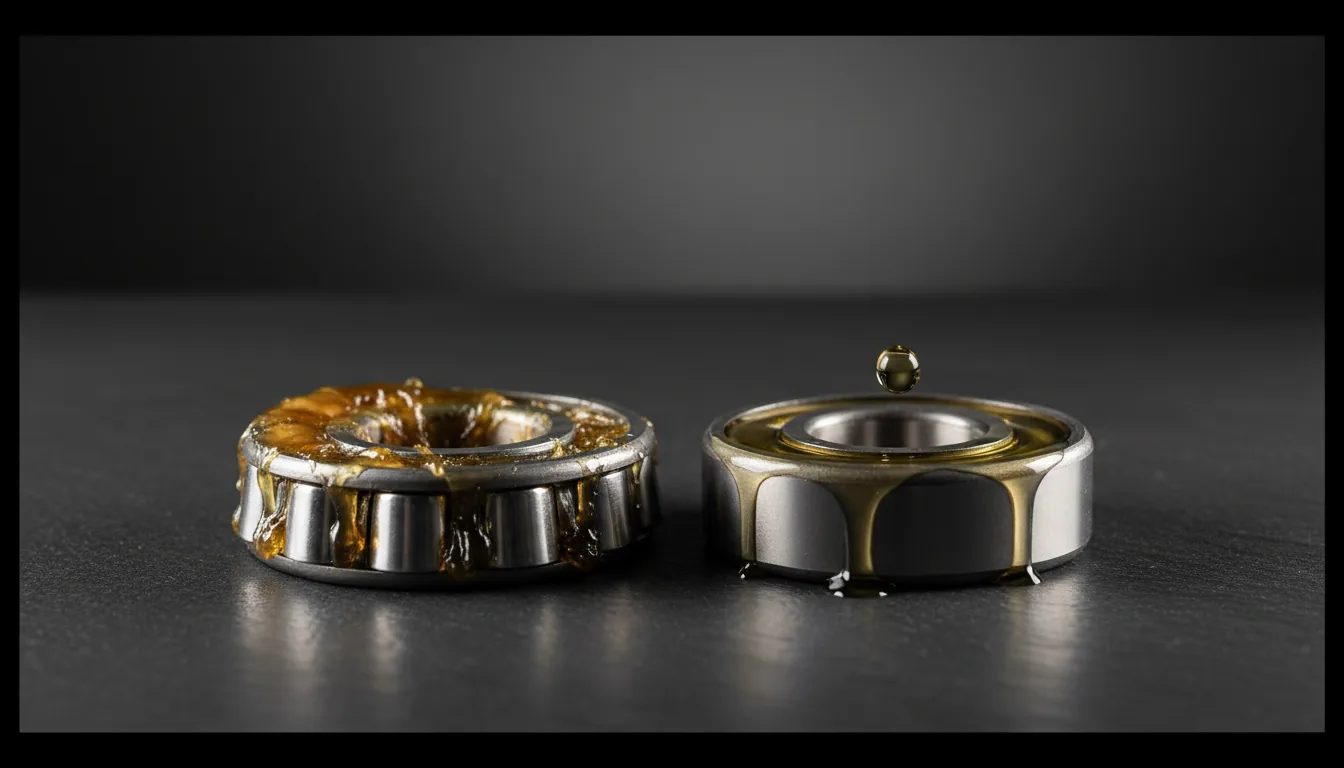
Grease is the optimal lubrication for low-to-medium speed industrial bearings, while oil is required for high-speed or high-temperature applications to maximize HI-TEC ASIA bearing lifespans. Choosing between grease vs oil bearing lubrication is one of the most critical maintenance decisions plant engineers face. The wrong choice leads to premature wear, increased friction, and costly machine downtime.
While grease is convenient and easy to apply, it cannot dissipate heat effectively at extreme velocities. Conversely, oil flows freely to cool moving parts but requires complex sealing mechanisms to prevent leaks. This guide breaks down the exact speed thresholds, temperature limits, and environmental conditions that dictate when to use grease vs oil, ensuring your machinery runs smoothly and your bearings achieve their maximum design life.
When should you use grease instead of oil for bearing lubrication?
You should use grease instead of oil when your industrial bearings operate at low-to-medium speeds and continuous temperatures below 110 °C, while oil is necessary for extreme speeds and continuous high heat. Proper selection between grease and oil lubrication directly extends the operational lifespan and reduces maintenance costs for premium HI-TEC SILVER industrial bearings.
The decision largely depends on the bearing's speed factor (ndm) and its operating temperature. Standard lithium greases perform best when kept below 100 to 110 °C continuously, as critical life degradation begins above 70 °C[1][2][3]. When continuous bearing temperatures approach 130 to 150 °C, industrial practice dictates moving to oil lubrication to prevent lubricant breakdown[4][3].
Speed is equally restrictive. For deep groove ball bearings, grease is generally suitable up to a speed factor (ndm) of 300 000 to 400 000[5][6]. Once the ndm exceeds 400 000 to 500 000, industrial applications must transition to oil bath, mist, or jet systems[7][8][6]. These advanced oil systems can support ndm values from 450 000 up to 1 000 000 and beyond[5][6].
| Operating Condition | Grease Lubrication | Oil Lubrication |
|---|---|---|
| Speed Limit (ndm) | Suitable up to 400 000[5][6] | Required above 400 000 to 500 000[7][8][6] |
| Temperature Limit | Reliable up to 110 °C[1][2] | Required for 130 to 150 °C and above[4][3] |
| Maintenance Setup | Simple, requires periodic repacking | Complex, requires pumps, filters, and tight seals |
If your machinery operates within standard parameters, grease is the most cost-effective choice. To explore our full range of durable components designed for these conditions, browse the HI-TEC SILVER industrial bearings product catalog.
Does oil or grease provide better cooling and sealing for bearings?
Oil lubrication provides superior cooling for HI-TEC bearings operating at extreme temperatures, whereas grease acts as an effective secondary seal against dust and contaminants. High-speed bearing oil is essential when operating temperatures exceed the limits of standard grease thickeners, as oil actively circulates to carry heat away from the rolling elements.
The fundamental physical differences between the two lubricants dictate their secondary benefits. Oil is a fluid that flows continuously through the bearing housing. As it circulates, it absorbs friction-generated heat and transfers it away from the contact zones. This continuous flushing action also removes microscopic wear particles, preventing them from grinding against the raceways. However, oil provides almost no sealing capability on its own and requires tightly engineered external seals to prevent leaks.
Grease, being a semi-solid mixture of base oil and a thickener, stays precisely where it is applied. This consistency allows grease to form a robust physical barrier around the bearing. It effectively blocks moisture, dirt, and industrial debris from entering the housing, making it the preferred choice for dusty agricultural or mining environments.
- Cooling capability: Oil dissipates heat rapidly through circulation. It is mandatory for high-speed spindles and heavy-duty gearboxes where friction generates severe temperatures.
- Sealing performance: Grease physically blocks external contaminants. It acts as a protective collar, keeping environmental hazards away from the inner and outer rings.
- Maintenance demands: Oil systems require constant monitoring of levels, filters, and pump pressure. Grease requires scheduled manual repacking but demands less daily oversight.
For detailed guidance on implementing these maintenance routines, consult our HI-TEC ASIA bearing maintenance and engineering support services to keep your equipment running quietly and reliably.
Frequently Asked Questions
When should I use grease instead of oil for bearing lubrication?
You should use grease when your bearings operate at low-to-medium speeds (ndm under 400 000) and continuous temperatures below 110 °C. Grease is cost-effective, stays in place, and requires simpler housing designs without complex leak-proof seals.
What is the best lubrication for high-speed industrial bearings?
High-speed bearing oil is the best lubrication for extreme velocities. When the speed factor (ndm) exceeds 400 000 to 500 000, oil bath, mist, or jet systems are required to maintain a stable lubricating film and prevent catastrophic failure.
Does oil or grease provide better cooling for bearings?
Oil provides significantly better cooling for bearings. Because oil flows and circulates through the housing, it actively absorbs heat generated by friction and carries it away from the rolling elements, whereas grease traps heat inside the bearing.
How does lubrication affect the lifespan of HI-TEC bearings?
Proper lubrication directly extends the lifespan of HI-TEC bearings by preventing metal-to-metal contact, reducing friction, and minimizing wear. Using the correct grease or oil prevents premature failure, ensuring the bearing achieves its maximum designed operational life and reduces costly machine downtime.
References
- Rolling Bearing Lubrication. https://www.schaeffler.com/remotemedien/media/_shared_media/08_media_library/01_publications/schaeffler_2/publication/downloads_18/wl_81115_4_de_en.pdf (2026-07-13)
- Selecting a suitable grease | SKF. https://www.skf.com/group/products/rolling-bearings/principles-of-rolling-bearing-selection/bearing-selection-process/lubrication/selecting-a-suitable-grease (2026-07-24)
- High-Temperature Lubrication Best Practices | EuroBearing. https://eurobearing.eu/industrial-lubrication-best-practices-high-temperature-service/ (2026-07-01)
- [PDF] Bearing Lubrication - SKF. https://cdn.skfmediahub.skf.com/api/public/0941f795342272f4/pdf_preview_medium/0941f795342272f4_pdf_preview_medium.pdf (2026-03-04)
- BEARING INSTALLATION AND MAINTENANCE GUIDE. https://cdn.skfmediahub.skf.com/api/public/0901d1968024f02a/pdf_preview_medium/0901d1968024f02a_pdf_preview_medium.pdf (2026-08-01)
- Bearing Speed Limits (ndm) Guide - ToolGrit. https://www.toolgrit.com/guides/bearing-speed-limits-explained (2026-02-13)
- Selecting The Right Grease | Agg-Net. https://www.agg-net.com/resources/articles/maintenance-repair/selecting-the-right-grease (2012-07-30)
- Lubrication condition – the viscosity ratio, κ | SKF. https://www.skf.com/group/products/rolling-bearings/principles-of-rolling-bearing-selection/bearing-selection-process/bearing-size/size-selection-based-on-rating-life/lubrication-condition-the-viscosity-ratio-k (2026-07-24)