

Deep Groove vs Angular Contact Bearings: 2026 Selection Guide
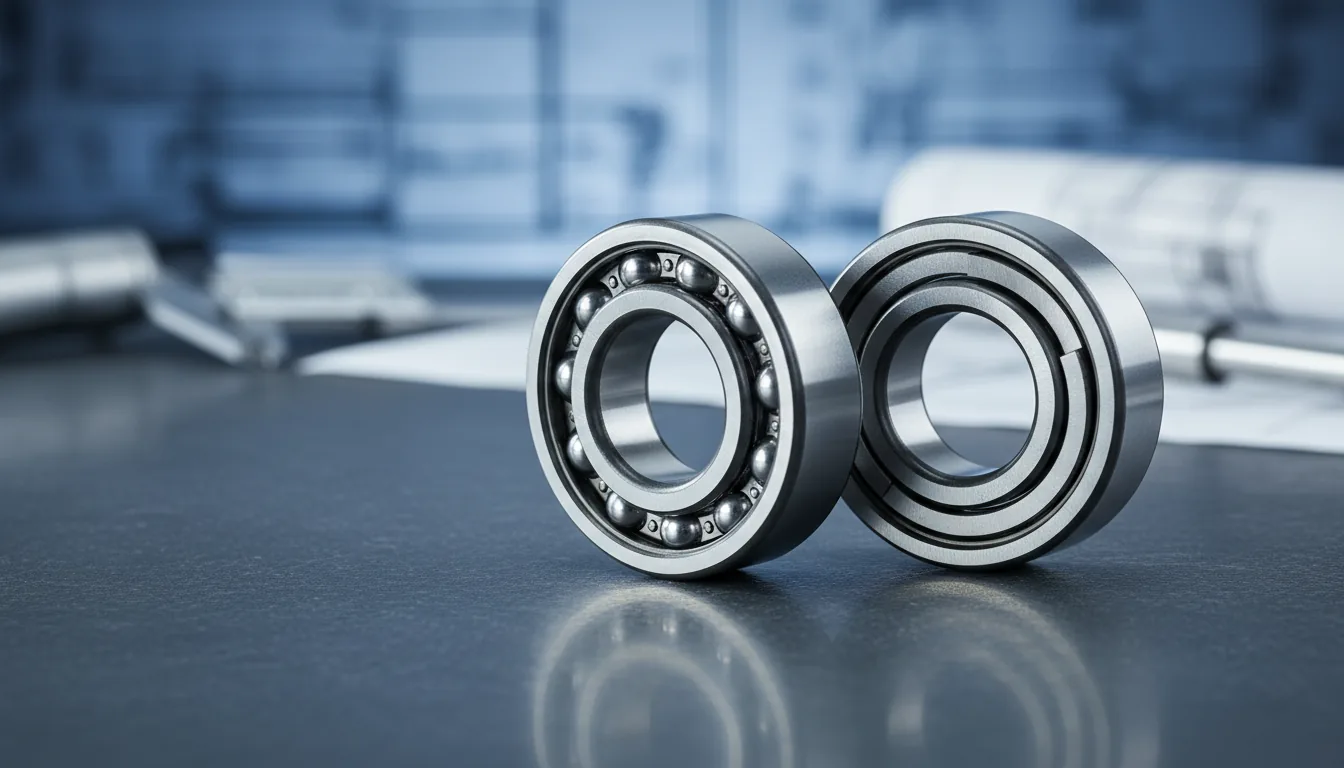
The primary difference between deep groove vs angular contact bearings is their load-handling capability: deep groove ball bearings manage mostly radial loads, while angular contact bearings utilize contact angles up to 40 degrees to support combined radial and axial loads. Selecting the incorrect bearing type can lead to premature failure, costly machine downtime, and higher maintenance expenses for industrial operations. Whether you are maintaining factory machinery in Jakarta or upgrading pumps in Surabaya, understanding these structural differences ensures you choose the right component the first time. This guide compares both bearing types, details how load direction dictates your selection, and explains how HI-TEC ASIA's reliable product lines keep your equipment running smoothly.
What is the difference between deep groove and angular contact bearings?
Deep groove ball bearings have a nominal contact angle of 0° and are optimized to support high radial loads alongside moderate axial loads in both directions[1][2]. In contrast, angular contact ball bearings are manufactured with fixed built-in contact angles - most commonly 15°, 25°, 30°, and 40° - that do not typically exceed 40° in standard ball bearing practice[3][4][5]. This engineered angle allows them to handle significantly higher axial (thrust) loads in one direction, though it reduces their pure radial load capacity compared to a similarly sized deep groove bearing[6][7][8].
The mechanical difference lies in the raceway geometry. In a deep groove design, the load line passes straight through the radial plane. When you switch to an angular contact bearing, the load line is inclined. As the contact angle increases toward 40°, the bearing's axial rigidity and thrust capacity increase, but its maximum rotational speed and radial limits decrease[6][9][8].
| Feature | Deep Groove Ball Bearings | Angular Contact Ball Bearings |
|---|---|---|
| Primary Load Type | High radial, moderate axial[1] | High combined (radial + heavy axial)[10] |
| Contact Angle | Nominal 0°[1] | Fixed at 15°, 25°, 30°, or 40°[5][11] |
| Axial Directionality | Both directions (moderate)[2] | Single direction per bearing (high)[2] |
| Dynamic Load Rating | Higher radial rating per size[1] | Higher axial rating per size[12][10] |
Selecting the wrong bearing type can cause catastrophic machine failure, making it critical to evaluate both radial and axial load requirements before purchasing from a distributor like HI-TEC ASIA. A deep groove bearing subjected to heavy, continuous thrust will wear out rapidly. Conversely, an angular contact bearing installed where only pure radial forces exist will lack the required load-sharing efficiency. By exploring the HI-TEC ASIA industrial bearing catalog, maintenance teams can source the exact dimensions and load profiles needed to prevent costly downtime.
When should you choose an angular contact bearing over a deep groove bearing?
Deep groove ball bearings are ideal for standard electric motors, whereas angular contact bearings from the HI-TEC SILVER tier excel in precision spindles requiring high axial rigidity. Your choice depends entirely on the machinery's operational demands, specifically the presence of thrust forces and the need for shaft control. Deep groove bearings are the default choice for general-purpose applications because they offer lower friction, simpler mounting, and efficient performance under mostly radial loading[13][14]. You will find them inside standard workshop motors, conveyor rollers, and industrial fans across manufacturing plants in Bekasi and Cikarang.
However, when a machine introduces heavy thrust or demands strict rotational accuracy, an angular contact bearing becomes necessary. They are preferred when the design must control deflection, runout, and axial thrust, especially in precision-drive systems[1][15].
Application Selection Criteria
- Standard Electric Motors: Choose deep groove bearings. They easily locate the rotor axially while supporting the primary radial weight of the spinning shaft[14].
- Precision CNC Spindles: Choose angular contact bearings. High-speed spindle systems require high rotary accuracy, low temperature rise, and high stiffness[15][16]. Matched pairs are often preloaded to eliminate internal clearance.
- Heavy Gearboxes & Pumps: Choose angular contact bearings if the helical gears or impellers generate significant axial thrust[1][17].
HI-TEC SILVER bearings are engineered to handle high-speed industrial applications, ensuring reliable performance under demanding combined load conditions. Upgrading to the HI-TEC SILVER premium bearing product line provides the high-quality materials and extended service life needed for these rigorous environments. If your facility faces frequent bearing replacements due to load mismatch, contact the HI-TEC ASIA team to get started and secure the right components for your fleet.
Frequently Asked Questions
What is the difference between deep groove and angular contact bearings?
The primary difference is that deep groove ball bearings handle mostly radial loads with a 0° contact angle, while angular contact bearings use built-in contact angles up to 40° to support heavy combined radial and axial loads.
Can a deep groove ball bearing take an axial load?
Yes, deep groove ball bearings can tolerate moderate axial loads in both directions. However, they are not designed to withstand heavy, continuous thrust forces, which will cause premature wear and unexpected machine downtime.
When should I use an angular contact bearing instead of a deep groove bearing?
You should use an angular contact bearing when your application involves significant axial thrust, such as in precision CNC spindles, heavy-duty pumps, or gearboxes. They provide the necessary axial rigidity and shaft control that standard bearings lack.
Are HI-TEC SILVER bearings suitable for high-speed industrial applications?
Yes, the HI-TEC SILVER premium tier is manufactured using high-quality materials designed for longer service life and reliable performance. They are ideal for demanding, high-speed industrial applications where reducing maintenance and downtime is critical.
References
- Deep Groove vs Angular Contact Ball Bearings: Selection Guide. https://www.ftmbearings.com/news/industry-news/engineering-guide-on-ball-bearings-deep-groove-vs-angular-contact.html (2026-06-21)
- What Are the Differences Between Bearings? The various .... https://koyo.jtekt.co.jp/en/bearing-column/bearing_trivia_1st_series/bearing_trivia_1st_series_04.html (2019-09-24)
- Deep Groove vs. Angular Contact Bearings: Choosing the .... https://www.sanyabearing.com/news/deep-groove-vs-angular-contact-bearings-choosing-the-right-one.html (2025-09-10)
- Angular Contact Ball Bearings - an overview. https://www.sciencedirect.com/topics/engineering/angular-contact-ball-bearings (2025-09-27)
- 2.2—Angular Contact Ball Bearings. https://www.nsk.com/tools-resources/abc-bearings/angular-contact-ball-bearings/ (2024-07-11)
- Angular Contact Ball Bearings: Types, Angles & Selection Guide. https://www.aosen-bearing.com/news/industry-news/what-are-angular-contact-ball-bearings-a-complete-guide.html (2026-07-08)
- Angular Contact Bearings Review. https://www.engineersedge.com/bearing/angular_contact_bearings.htm (2025-11-03)
- LARGE SIZE BALL & ROLLER BEARINGS. https://koyo.jtekt.co.jp/en/support/catalog-download/uploads/catbs008en.pdf (2025-03-17)
- How to distinguish the angle of angular contact ball .... https://www.tedin-bearing.com/info/how-to-distinguish-the-angle-of-angular-contac-48448875.html (2020-08-06)
- Angular Contact Bearing. https://www.hisupplier.com/product-572416-Angular-Contact-Bearing/ (2026-06-27)
- TIMKEN® ANGULAR CONTACT BALL BEARING CATALOG. https://www.timken.com/resources/timken-angular-contact-ball-bearing-catalog_11193/ (2026-07-17)
- Angular Contact vs Deep Groove Ball Bearings. https://angularcontactballbearings.com/blog/angular-contact-vs-deep-groove-ball-bearings-a-comprehensive-comparison/ (2024-09-11)
- Deep Groove vs. Angular Contact Bearings: Which Is Best .... https://ebearingstore.com/blogs/products/deep-groove-vs-angular-contact-bearings-which-is-best-for-your-application (2025-09-14)
- Rolling bearings and seals in electric motors and generators. https://cdn.skfmediahub.skf.com/api/public/0901d196802b0348/pdf_preview_medium/13459_EN_Rolling_bearings_and_seals_in_electric_motors_and_generators_pdf_preview_medium.pdf (2026-07-13)
- Book-of-Spindles-Part-1.pdf. https://dynospindles.com/vault/technical/Book-of-Spindles-Part-1.pdf (2026-07-16)
- [PDF] A Review of Key Technologies for High-Speed Motorized Spindles .... https://pdfs.semanticscholar.org/81e7/53ba5526be4ef2ee849d884d69637d369438.pdf (2025-10-02)
- Technical Report. https://www.nsk.com/content/dam/nsk/common/catalogs/ctrgPdf/bearings/e728.pdf (2025-01-27)