

Deep Groove vs Angular Contact Ball Bearings: 2026 Guide
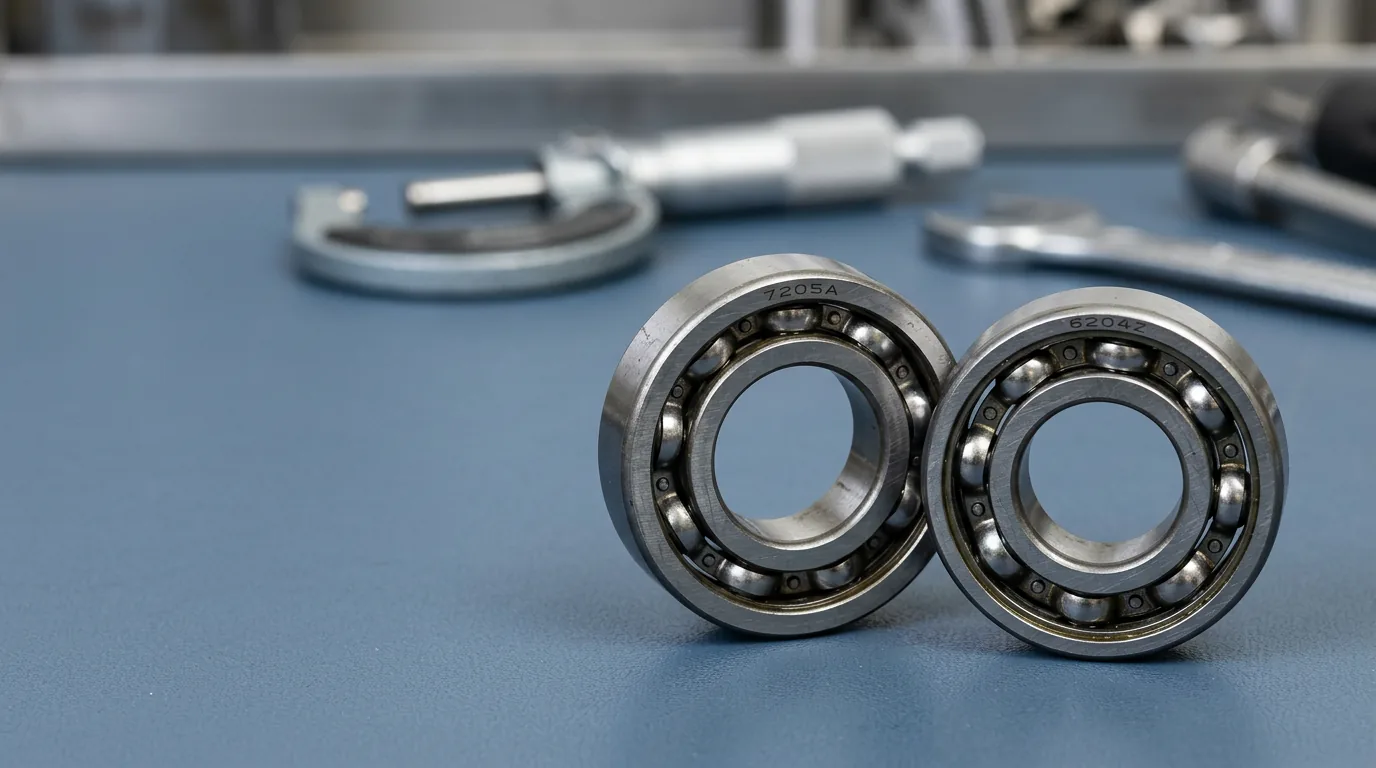
Deep groove ball bearings handle moderate radial loads for electric motors, while angular contact bearings manage heavy combined loads in one direction for precision spindles. Choosing the correct bearing type dictates whether industrial machinery operates efficiently or suffers from premature failure and costly machine downtime. Upgrading to the right specification ensures proper load distribution. This guide compares their load capacities, speed limits, and critical installation differences to help maintenance engineers select the optimal solution.
What is the difference between deep groove and angular contact ball bearings?
Deep groove ball bearings handle moderate radial loads for electric motors, while angular contact bearings manage heavy combined loads in one direction for precision spindles[1][2]. The primary difference lies in their internal geometry.
Deep groove ball bearings have an effective contact angle of about 0° under pure radial loading[3][4]. This design makes them the ideal choice for high-speed, lower-cost, radial-load-dominant applications where simplicity matters most[1][5][6]. They carry axial loads in both directions, but only to a limited extent compared with angular contact bearings[1][6].
In contrast, angular contact bearings feature a built-in contact angle that allows them to support significantly higher axial loads than standard 6000-series deep groove models[1][2]. The load path transfers through this specific contact angle, typically 15°, 25°, 30°, or 40°[2]. A larger contact angle increases axial load capacity, while a smaller angle favors higher rotational speeds[3][2]. Because single-row angular contact bearings only carry axial load in one direction, they are used in pairs when bidirectional axial load support is needed[1][2].
Which bearing type is best for your application's load capacity?
Angular contact bearings are the optimal choice for heavy axial loads and combined radial-axial forces. Upgrading to premium HI-TEC SILVER bearings ensures proper load distribution, reducing premature machine failure and costly downtime in heavy industrial applications. Selecting the right bearing depends on comparing specific load ratios and rotational speeds. If axial load is comparable to radial load, an angular contact bearing is required[7][8].
| Specification | Deep Groove Ball Bearings | Angular Contact Ball Bearings |
|---|---|---|
| Primary Load Type | Heavy radial, light axial[1][6] | Heavy combined radial and axial[9][8] |
| Axial Load Direction | Bidirectional (limited capacity)[1][6] | Unidirectional (single-row)[7][10] |
| Contact Angle | Approximately 0°[3][4] | 15°, 25°, 30°, or 40°[2][8] |
| Speed Limits | High speed, low friction[1][5] | High speed (decreases as angle increases)[3][2] |
| Typical Applications | Electric motors, fans, gearboxes[11][5][12] | Precision spindles, machine tools, robotics[3][1][2] |
For general factory machinery, a standard 6303 deep groove ball bearing provides quiet operation and cost-effectiveness[11][5][6]. When an application demands high rigidity and precision, angular contact bearings deliver the necessary stability[3][1][2].
Does installation direction matter for angular contact bearings?
Maintenance engineers must verify installation direction for angular contact bearings, as mounting a 7000-series bearing backward will cause immediate mechanical failure and machine downtime[7][13]. Proper alignment and thrust face orientation must be verified before final housing assembly.
Unlike symmetrical deep groove bearings, single-row angular contact bearings feature an asymmetric raceway with one higher shoulder designed to carry the axial load[7][10][14]. Installing them backward leads to severe consequences:
- Identify the thrust face: The bearing must be mounted so the working axial load pushes rolling elements toward the higher shoulder[7].
- Avoid the filling slot: Backward mounting pushes elements toward the low shoulder, greatly reducing axial capacity[7].
- Prevent abnormal clearance: Incorrect orientation causes uneven contact and improper axial preloading, leading to localized fatigue and shortened bearing life[13][15].
- Monitor temperatures: Backward mounting acts like internal axial misalignment, increasing friction and causing hot running[13].
For additional maintenance insights, refer to our bearing failure guide.
Can I replace a deep groove bearing with an angular contact bearing?
Replacing a deep groove bearing with a single angular contact bearing is generally not recommended unless the axial load is strictly unidirectional[7][10]. Duplex or paired angular contact configurations should be used if replacing deep groove bearings in applications with reversing axial forces[7][8]. Before swapping bearing types, maintenance teams must evaluate load dynamics and housing constraints.
- Check axial load magnitude: If axial load exceeds 30-40% of the radial load, a deep groove bearing is no longer optimal, and upgrading to an angular contact bearing is justified[7][8].
- Evaluate load reversal: Single-row angular contact bearings only support axial load in one direction[7][16]. If forces reverse, use a duplex configuration (DB, DF, or DT)[7][8][17].
- Assess stiffness requirements: For machine tool spindles, duplex angular contact arrangements provide higher rigidity and stable contact conditions compared to deep groove bearings[14][15].
- Verify alignment tolerances: While deep groove bearings tolerate minor misalignment, angular contact bearings require careful alignment. A back-to-back (DB) duplex pair provides a stiff arrangement capable of carrying significant overturning moments[17].
Frequently Asked Questions
What is the difference between deep groove and angular contact ball bearings?
Deep groove ball bearings primarily handle radial loads with a 0° contact angle, ideal for electric motors. Angular contact bearings feature a built-in contact angle to support heavy combined radial and axial loads in one direction for precision spindles.
Can I replace a deep groove bearing with an angular contact bearing?
Yes, if the application involves heavy axial loads. Because single-row angular contact bearings only support axial forces in one direction, reversing loads require a paired duplex configuration.
Which bearing type is best for heavy axial loads?
Angular contact ball bearings are the optimal choice. Their higher shoulder and specific contact angle transfer axial forces efficiently, whereas deep groove bearings have limited axial capacity.
Does installation direction matter for angular contact bearings?
Yes. Angular contact bearings must be installed so the axial load pushes against the higher raceway shoulder. Mounting them backward causes immediate loss of load capacity, overheating, and premature failure.
References
- What Are the Differences Between Bearings? The various types and .... https://koyo.jtekt.co.jp/en/bearing-column/bearing_trivia_1st_series/bearing_trivia_1st_series_04.html (2019-09-24)
- 2.2—Angular Contact Ball Bearings | NSK Global. https://www.nsk.com/tools-resources/abc-bearings/angular-contact-ball-bearings/ (2024-07-11)
- The difference between angular contact bearings and deep groove .... https://www.linkedin.com/pulse/difference-between-angular-contact-bearings-deep-groove-bill-liu (2021-02-22)
- Angular Contact Bearings vs. Radial Bearings: What's the Difference?. https://www.youtube.com/watch?v=JnI1s1665w0 (2024-01-22)
- Advantages of Deep Groove Ball Bearings Over Other Bearing Types. https://blog.nskamericas.com/advantages-of-deep-groove-ball-bearings-over-other-bearing-types (2024-05-02)
- Deep Groove Ball Bearings - an overview | ScienceDirect Topics. https://www.sciencedirect.com/topics/engineering/deep-groove-ball-bearings (2025-10-01)
- Prinsip dan Perawatan Bantalan Gelinding | PDF - Scribd. https://id.scribd.com/doc/316315330/Teknik-Perawatan-Part-II (2025-04-26)
- Perbedaan Antara Bantalan Kontak Sudut Dan Bantalan Bola Alur .... https://id.bearingmotion.com/news/differences-between-angular-contact-bearings-a-70669821.html (2023-09-04)
- Apa karakteristik dan aplikasi bantalan bola kontak sudut?. https://id.sgsabearing.com/info/what-are-the-characteristics-and-applications-82178367.html (2023-04-07)
- Semua Yang Harus Anda Ketahui Tentang Bantalan Kontak Sudut. https://www.aubearing.com/id/everything-you-should-know-about-angular-contact-bearings/ (2024-02-24)
- Deep Groove Ball Bearing Vs. Angular Contact Ball Bearing. https://lkpbearing.com/deep-groove-ball-bearing-vs-angular-contact-ball-bearing/ (2024-05-28)
- Deep groove ball bearings uses and applications - Pibsales. https://pibsales.com/bearings/deep-groove-ball-bearings-uses-and-applications/ (2022-12-02)
- Faktor-faktor apa yang mempengaruhi masa pakai bantalan bola .... https://id.zjwxbearing.com/blog/what-factors-affect-the-service-life-of-angular-contact-ball-bearings-2136223.html (2025-12-15)
- Bagaimana tampilan bantalan bola kontak sudut? - Pengetahuan. https://id.hkbearingservice.com/info/how-do-angular-contact-ball-bearings-look-84557018.html (2023-04-03)
- [PDF] Digital Repository Universitas Jember - Semantic Scholar. https://pdfs.semanticscholar.org/7189/66ab61c150ca8ddb6c3f7338e59174cafabe.pdf (2024-09-19)
- Jenis dan aplikasi bantalan kontak bola sudut. https://id.yujebearing-machining.com/info/angular-contact-ball-bearing-types-and-applica-43268174.html (2020-02-18)
- Mengapa bantalan bola kontak sudut digunakan dalam konfigurasi .... https://id.tedinbearing.com/info/why-is-angular-contact-ball-bearing-used-in-ba-53638187.html