

Deep Groove vs Angular Contact Ball Bearings: 2026 Guide
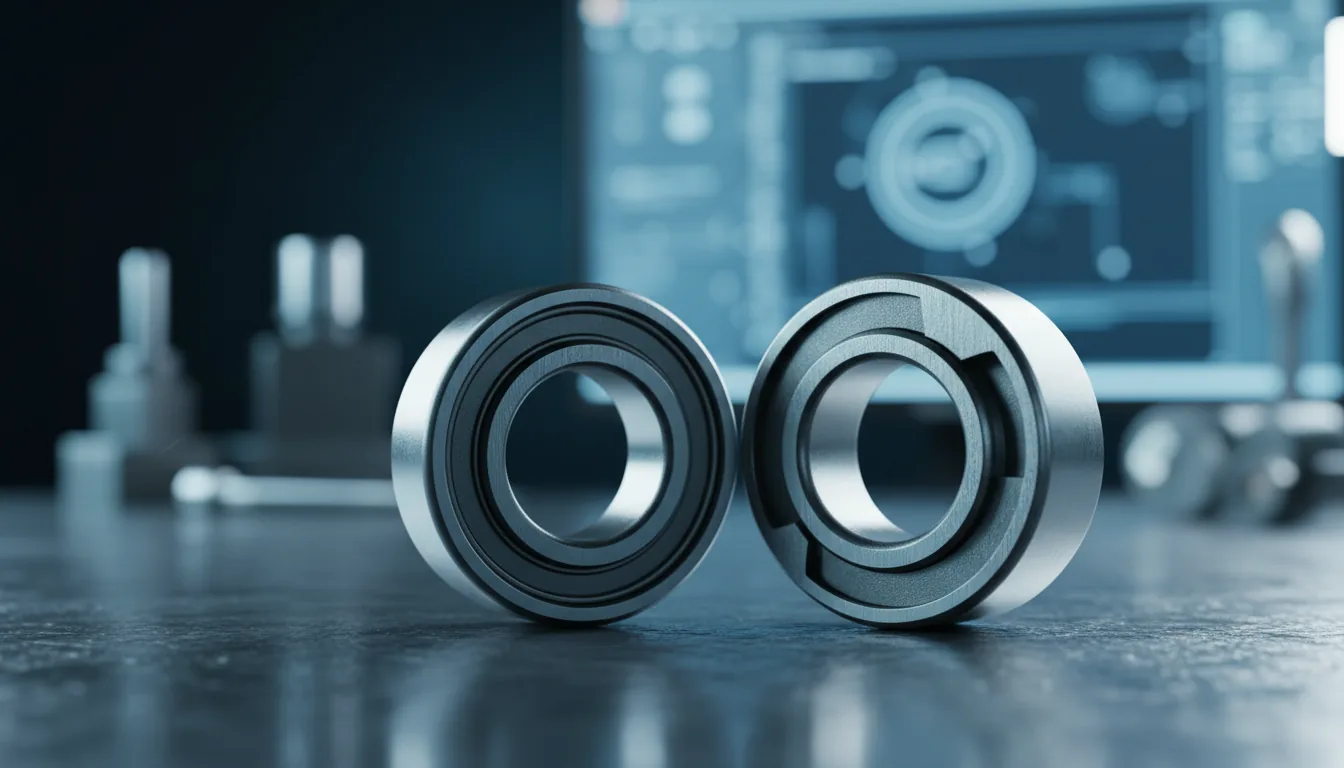
The primary difference is that HI-TEC deep groove ball bearings handle mainly radial loads, while angular contact bearings handle combined radial and axial loads in one direction. Applying incorrect load types causes premature failure, making it critical for plant engineers and mechanics to select the exact HI-TEC bearing based on specific radial and axial load requirements.
Deep groove ball bearings provide the best combination of simplicity, speed, and moderate two-direction axial support, but their axial capacity is limited relative to radial capacity[1][2][3]. In contrast, angular contact ball bearings sacrifice some radial capacity to gain significantly higher axial capacity and stiffness[1][4]. This technical guide compares load capacities, speeds, and application limits to help Indonesian workshop technicians choose the correct bearing type, prevent unexpected machine downtime, and maximize the lifespan of their rotating equipment.
What is the difference between deep groove and angular contact ball bearings?
The core difference lies in their internal geometry: deep groove ball bearings distribute load symmetrically to support heavy radial forces, whereas angular contact bearings use an offset contact angle to support heavy thrust forces in one direction[2][4]. Understanding this physical difference is the first step in proper bearing selection.
Under pure radial load, ball-to-raceway contact in a deep groove bearing remains near the radial plane, which minimizes friction and allows for very high rotational speeds[4][5]. Because of their symmetric raceway grooves, they can also support moderate axial load in both directions[6][1]. A common engineering guideline states that pure axial load on a deep groove bearing should generally not exceed 25% to 50% of its basic static load rating, depending on the specific series and operating clearance[7][8][9]. Pushing beyond this limit forces the balls against the raceway shoulder, accelerating fatigue.
In contrast, angular contact ball bearings are deliberately manufactured with a built-in contact angle - commonly 15°, 25°, or 40°[10][2][4]. As this contact angle increases, the axial load carrying capacity increases significantly because the load transfers through the balls at an angle, preventing unfavorable shoulder contact[2][5]. However, a standard single-row angular contact bearing only carries axial load in one direction, meaning they are frequently installed in pairs when thrust forces reverse[11][10][3].
| Feature | Deep Groove Ball Bearing | Angular Contact Ball Bearing |
|---|---|---|
| Primary Strength | Radial load capacity | Combined radial and axial load capacity |
| Axial Load Direction | Both directions (moderate loads) | One direction per bearing (heavy loads) |
| Internal Geometry | Symmetric deep raceways | Built-in contact angle (e.g., 15°, 25°, 40°) |
| Speed Capability | Extremely high due to low friction | High, but limited by contact angle and preload |
For a deeper look at how these specifications impact performance, review our Deep Groove vs Angular Contact Bearings: 2026 Selection Guide.
How do I choose between deep groove and angular contact bearings?
Choose deep groove bearings like the 6200 series for machinery driven by pure radial loads, such as standard electric motors, and select 7000 series angular contact bearings for equipment generating heavy axial thrust, like precision pumps[11][12][13]. Deep groove and angular contact bearings are not directly interchangeable, as swapping them without verifying load parameters guarantees premature failure.
To make the correct choice for your plant or workshop, evaluate your equipment against these application criteria:
- Standard Electric Motors: The 6200 series deep groove ball bearing is usually the default choice because standard motors generate mainly radial load, moderate axial load in both directions, and require high speeds with low friction[11][14][13]. They keep maintenance low and efficiency high.
- Precision and Centrifugal Pumps: For small-to-medium centrifugal pumps, deep groove bearings handle the radial demands perfectly[15][16]. However, high-speed centrifugal pumps with notable hydraulic thrust require the 7000 series angular contact bearings, often installed in pairs to manage thrust in both directions and maintain strict axial position control[15][17][18].
- Vertical Shaft Applications: Vertical motors with heavy rotors generate constant, significant one-directional thrust. In these scenarios, angular contact bearings are justified to prevent the raceway wear that would destroy a standard radial bearing[11][19][13].
Selecting the right HI-TEC or HI-TEC SILVER bearing tier ensures long service life and minimal downtime. If you are unsure which geometry fits your machinery, review our comprehensive Deep Groove vs Angular Contact Ball Bearings: 2026 Guide or contact our Jakarta team to book a call and consult on your specific load requirements.
Frequently Asked Questions
What is the difference between deep groove and angular contact ball bearings?
The primary difference is their load handling capability dictated by internal geometry. Deep groove ball bearings are designed mainly for radial loads and moderate axial loads in both directions[6][1]. Angular contact ball bearings feature a built-in contact angle that allows them to support much heavier combined radial and axial loads, typically in one direction per bearing[2][3].
Can I use a deep groove ball bearing for axial loads?
Yes, but only for moderate axial loads. Because of their symmetric raceways, deep groove bearings can support axial forces in both directions, generally limited to 25% to 50% of their basic static load rating depending on the specific series and size[7][8][9]. Heavy, sustained axial loads require an angular contact bearing.
Are deep groove and angular contact bearings interchangeable?
No, they are not directly interchangeable. Swapping them without accounting for the load type causes premature failure. Deep groove bearings will fail quickly under heavy axial thrust, while angular contact bearings can fail if they lack the required axial preload to keep the rolling elements seated properly.
How do I choose between deep groove and angular contact bearings?
Base your choice on the primary load direction of your machinery. Choose deep groove bearings for high-speed, purely radial applications like standard electric motors and fans[20][13]. Choose angular contact bearings for applications with heavy axial thrust or high precision requirements, such as high-pressure centrifugal pumps and vertical spindles[15][18].
References
- Deep groove ball bearings | Schaeffler medias. https://medias.schaeffler.co.uk/en/knowledge-center/rolling-bearings/deep-groove-ball-bearings (2014-01-01)
- Super precision bearings. https://www.schaeffler.com/remotemedien/media/_shared_media/08_media_library/01_publications/schaeffler_2/catalogue_1/downloads_6/sp1_de_en.pdf (2026-08-11)
- Single row angular contact ball bearings content | Schaeffler medias. https://medias.schaeffler.us/en/single-row-angular-contact-ball-bearings (2026-06-07)
- Deep Groove vs Angular Contact Ball Bearings: Selection Guide. https://www.ftmbearings.com/news/industry-news/engineering-guide-on-ball-bearings-deep-groove-vs-angular-contact.html (2026-06-21)
- [PDF] Ball Bearing Mechanics - NASA Technical Reports Server. https://ntrs.nasa.gov/api/citations/19810023007/downloads/19810023007.pdf (2026-02-20)
- Loads. https://www.skf.com/us/products/rolling-bearings/ball-bearings/deep-groove-ball-bearings/loads (2026-07-24)
- What Is the Difference Between Radial and Axial Load Capacity in .... https://www.sanyabearing.com/news/what-is-the-difference-between-radial-and-axial-load-capacity-in-deep-groove-ball-bearings-and-how-do-you-balance-both.html (2026-05-11)
- Radial and Axial Load Rating Information by SMB Bearings. https://www.smbbearings.com/technical/bearing-load-rating.html (2026-04-28)
- 6000 EN 01 DGBB. https://www.pkl.hr/download/lezajevi/6000_EN_01_DGBB.pdf (2025-11-03)
- Deep Groove Ball Bearing vs Angular Contact Ball Bearing. https://yuwei-bearing.com/zh/deep-groove-ball-bearing-vs-angular-contact-ball-bearing-a-precision-engineers-complete-comparison-guide/ (2026-08-01)
- Deep Groove Ball Bearings vs. Angular Contact: 5 key .... https://www.lily-bearing.com/resources/blog/deep-groove-ball-bearings-vs-angular-contact-bearings (2026-07-28)
- M190-730 June 2005. https://cdn.skfmediahub.skf.com/api/public/0901d19680208485/pdf_preview_medium/0901d19680208485_pdf_preview_medium.pdf (2025-03-24)
- The Role of Deep Groove Ball Bearings in Electric Motors. https://blog.nskamericas.com/the-role-of-deep-groove-ball-bearings-in-electric-motors (2024-05-06)
- SKF 6200 Bearing Specs Clean | PDF. https://www.scribd.com/document/892532826/SKF-6200-Bearing-Specs-Clean (2025-12-13)
- centrifugal pump bearing types. https://www.zhilong-pump.com/article/Industry-Knowledge/718.html (2025-05-27)
- Bearings in centrifugal pumps - SKF. https://cdn.skfmediahub.skf.com/api/public/0901d19680054a8a/pdf_preview_medium/0901d19680054a8a_pdf_preview_medium.pdf (2026-08-10)
- Angular Contact Bearings: When and Why to Use Them in 2026. https://eurobearing.eu/angular-contact-bearings-when-why-use-them-2026/ (2026-06-24)
- MRC. https://www.easternia.com/ASSETS/DOCUMENTS/ITEMS/EN/SKF_7210DU_Brochure.pdf (2025-11-03)
- Bearing Handbook for Electric Motors. https://cdn.skfmediahub.skf.com/api/public/0901d19680056c36/pdf_preview_medium/140-430_Bearing_EM_Handbook_Nov_2020_pdf_preview_medium.pdf (2026-07-15)
- Deep Groove Ball Bearing Guide: 6200/6300, Seals & .... https://aimsindustrial.com.au/blogs/product-guides/deep-groove-ball-bearing-guide (2026-04-29)